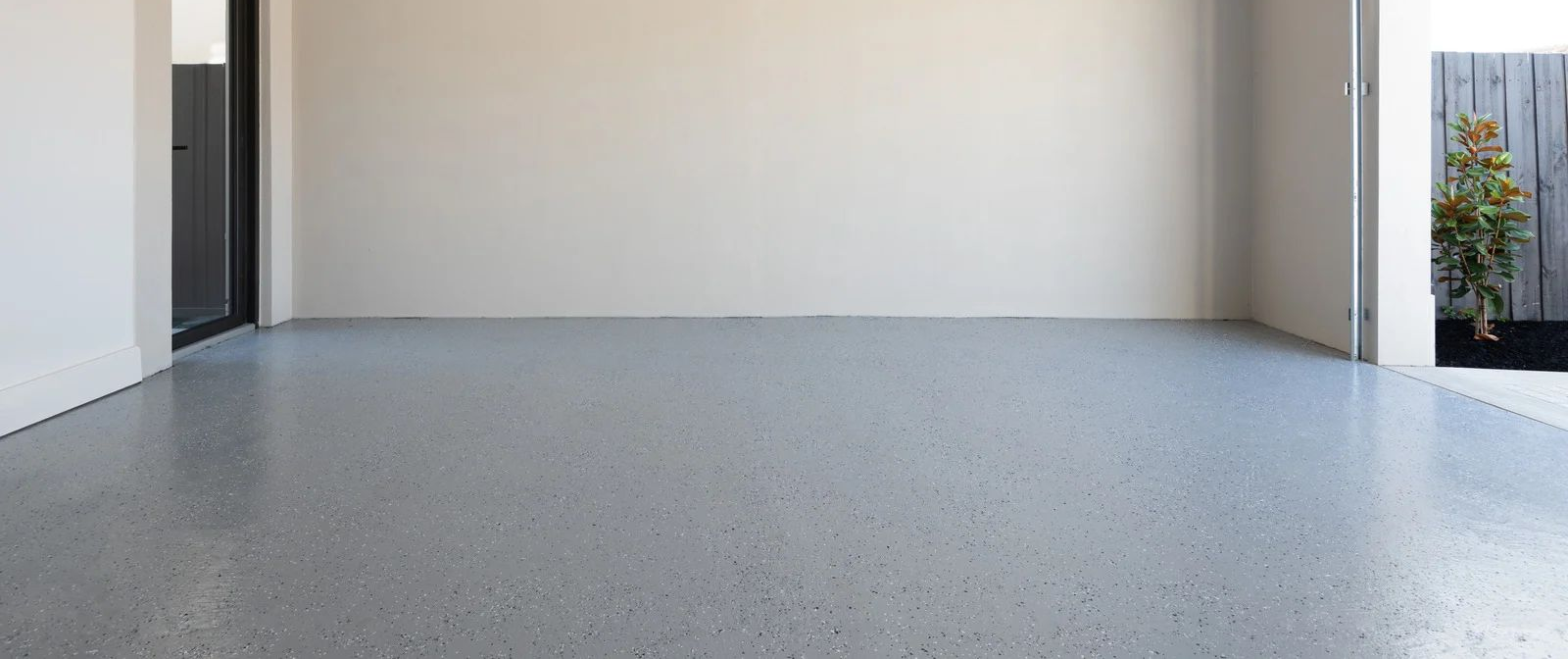
Hot Tires and Oil Spills: How an Epoxy Garage Floor Coating Holds the Line
July 25, 2026

QUICK ANSWER: A quality epoxy garage floor coating resists hot tire pickup because it is built to keep its bond and its hardness even when tire rubber heats past 120 degrees, so the softening agents that migrate out of hot rubber cannot grab or lift it. The same non-porous surface keeps oil, gasoline, and cleaning fluids sitting on top instead of soaking in, so most spills wipe away instead of staining. Thorough concrete grinding, crack repair, a penetrating base coat, and a hard wear topcoat are what make that resistance last.
It's the middle of a Missouri July. You back the truck into the garage after forty minutes on the highway, the tires still warm, and you shut the door for the night. Nothing about that feels destructive. But on a bare slab, or a floor finished with a thin paint-on product, that parking spot is exactly where the trouble starts. Come back in a few weeks and you might find dark rings, tacky patches, or a coating that has peeled up right where the tires sit. A properly installed epoxy garage floor is built so that never happens. Understanding why comes down to two things every garage sees constantly: heat off your tires and fluids off your vehicle.
What Hot Tire Pickup Actually Is
The rubber, not the road, does the damage
Friction between tire and pavement builds heat fast. On a hot day, a tire surface can climb well past 120 degrees, and 140 degrees is commonly cited for summer driving. Tires are made with plasticizers, the softening agents that keep rubber flexible, and as a tire heats up those plasticizers migrate to its surface. Park that hot tire on a floor and the plasticizers, along with the heat, go to work on whatever coating is underneath.
Why it looks like the floor is peeling
You pull into the same spot every day. So the same two or four patches take that heat and chemical contact over and over. On a low-grade coating, the heat can reactivate the curing chemistry and soften the film while the migrating plasticizers attack the bond. The coating turns tacky, sticks to the tread, and gets yanked up when you drive off the next morning. That's hot tire pickup. Not dirt, not a stain you can scrub, but a coating that has lost its grip on the concrete in the one place it's stressed the most.
Why Some Coatings Lift and a Real System Stays Put
Coating grade decides the outcome
Not every product called epoxy behaves the same way under a warm tire. Thin water-based sealers and bargain paint-on kits have low heat tolerance, so they're the ones that soften and stick to hot rubber. A professionally installed epoxy system is a different animal. It goes down thick, cures properly, and gets finished with a hard wear layer designed to shrug off the heat and the plasticizers instead of reacting to them.
The topcoat carries the load
The layer that meets your tires is the topcoat, and its hardness and chemistry are what stop plasticizer migration from ever reaching the color coat. High-performance topcoats, including the polyaspartic finishes used over an epoxy base, cure into a dense, heat-stable film with tight cross-linking and high solids content. That density is why a well-built floor keeps its gloss and its bond where a cheap one goes gummy.
Adhesion is earned at the concrete
A topcoat only matters if the whole system is anchored to the slab. When the bond is weak, a hot tire only has to break something fragile to peel the film. When adhesion is done right, the coating becomes part of the floor. In lab pull tests on properly bonded systems, the concrete itself gives way before the coating releases. That tells you the daily tug of a warm tire is not going to win.
TIP: If you're comparing installers, ask whether their warranty specifically covers hot tire pickup, sometimes written as plasticizer migration. A company that stands behind its system against that exact failure is telling you something about the products and prep it uses.
How Oil and Chemical Spills Meet a Non-Porous Surface
Bare concrete drinks everything
Raw concrete is porous. Drip motor oil, brake fluid, gasoline, or antifreeze on it and the liquid wicks down into the surface, where it leaves a stain no amount of scrubbing fully lifts. Road salt carried in on your tires soaks in the same way and works on the slab from the inside out. An uncoated garage floor ends up wearing a permanent map of every leak the vehicle has ever had.
A coated floor keeps spills on the surface
An epoxy system seals the concrete under a continuous, non-porous film. Oil and automotive chemicals have nowhere to go, so they bead and sit on top instead of penetrating. A rag or a mop handles most spills, and because the surface has no open pores or grout lines, there's nowhere for grime to lodge and set. The floor that resists hot tire pickup is beating oil for the same reason. It's a hard, closed surface bonded tight to the slab, not an open sponge.
The Prep and Layering That Make Resistance Possible
Grinding opens the concrete
Every honest floor coating starts with mechanical grinding, usually with diamond tooling, to strip off old coatings, curing compounds, and contaminants and to open the pores of the slab. That profile is what lets the base coat bite in. Skip it, or paint over a slick and dirty slab, and you've built the peeling failure into the floor before the first bucket is mixed.
Repairs come before coating
Cracks, pits, and spalled areas get filled and leveled before any color goes down. This restores a sound, even surface so the coating cures as one continuous membrane rather than bridging a moving crack that will telegraph through later. On slabs that show moisture, a vapor-mitigating base coat and moisture barrier can be added so humidity coming up through the concrete doesn't undermine the bond.
Base coat, flake, and topcoat work as a system
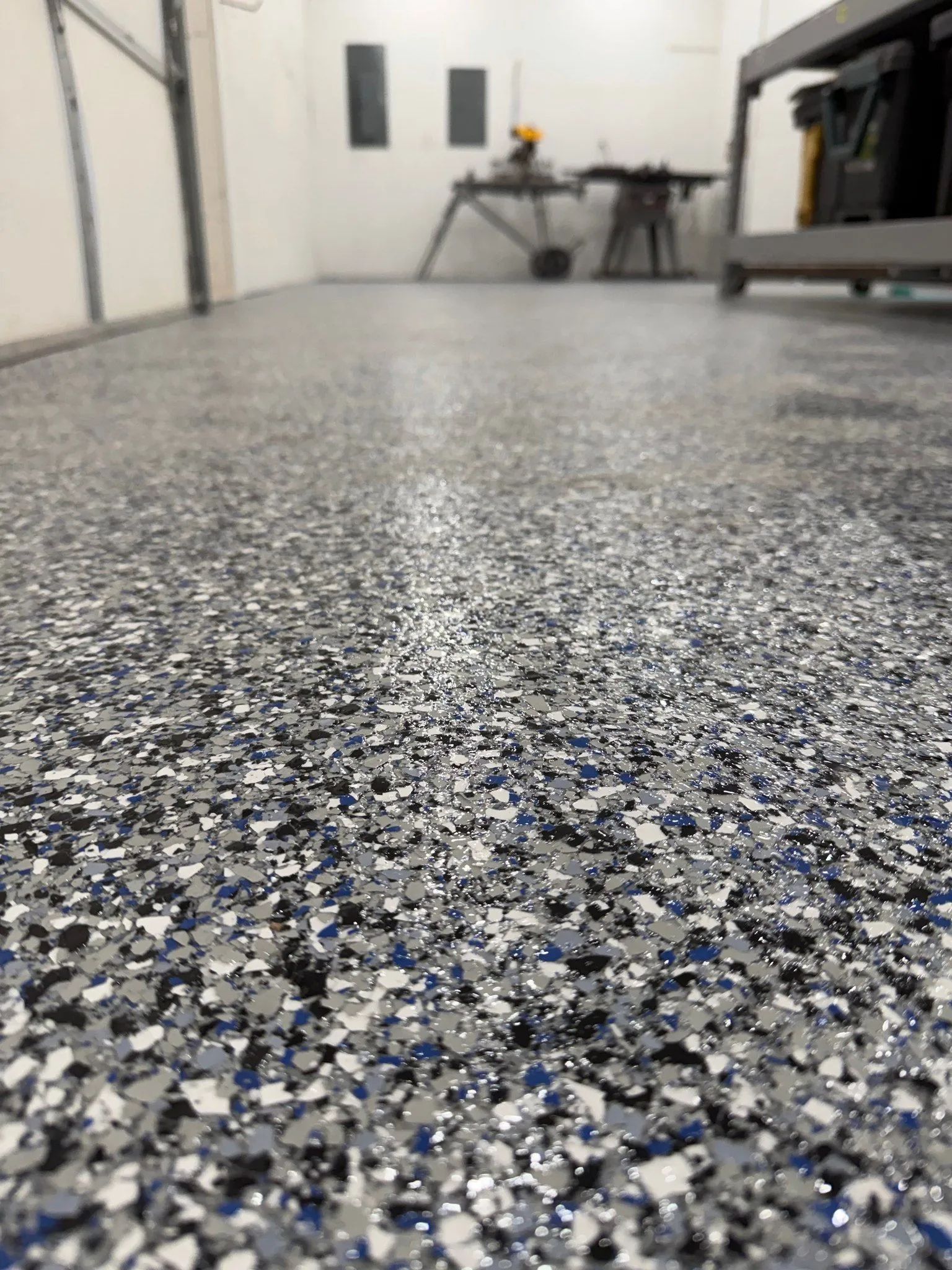
A penetrating epoxy base coat soaks into the ground profile and forms the anchor. Decorative flakes get broadcast into that base for texture, hide, and slip resistance. Then the hard topcoat seals the whole build, locks the flakes in, and provides the heat, stain, and abrasion resistance that faces your tires day to day. Every layer has a job, and the resistance to hot tires and oil is the product of all of them being done in the right order.
WARNING: One-day, paint-it-yourself kits and rushed single-coat jobs are the products most tied to hot tire pickup. If a floor is ground poorly or the coating goes on too thin, no topcoat can rescue it, and the failure usually shows up in the first hot summer right where you park.
Keeping the Floor Doing Its Job
A coated garage floor asks very little to keep performing. Sweep or dust-mop the grit that acts like sandpaper underfoot, and wipe up oil, fuel, and chemical spills when you notice them rather than letting them pool for weeks. For general cleaning, a soft mop and a mild cleaner are plenty. Skip harsh solvents and abrasive pads that can dull the topcoat over time. Because the surface is closed and continuous, cleaning is quick and the floor holds its finish for years. Handle those basics and the coating keeps doing the quiet work of resisting your tires and your spills, day after day.
Frequently Asked Questions
Does hot tire pickup happen to every epoxy garage floor?
No. It's tied to coating grade, thickness, and prep, not to the word epoxy itself. Thin water-based sealers and DIY kits soften under heat and bond weakly to the slab. Quality systems keep their bond.
How hot do tires actually get in a garage?
Friction with the road heats tire rubber quickly, and on a hot day the surface can reach past 120 degrees, with 140 often cited for summer driving. That heat softens weak coatings and drives plasticizers.
Can I get oil stains out of an epoxy garage floor?
On a quality coated floor, oil sits on the non-porous surface instead of soaking in, so most spills wipe up before staining. Bare, porous concrete causes the lasting stains people struggle with, not coated floors.
Is polyaspartic better than epoxy for hot tires?
They work best together. An epoxy base gives deep adhesion and acts as a moisture barrier, while a polyaspartic topcoat adds a hard, heat-stable surface resisting plasticizer migration. Strong systems pair both materials, not one.
Why does surface prep matter so much for tire resistance?
Because a hot tire pulls at the bond between coating and concrete. If the slab wasn't ground open, or left with dust or oil, that bond is weak and a warm tire can peel it.
How soon can I park on a new coated floor?
Curing time depends on the system and conditions, so the floor should stay free of traffic until the installer confirms it has hardened fully. Parking too early risks tire marks before film reaches full cure.
Built to Take the Heat and the Spills
Hot tires and leaking fluids aren't rare events in a garage. They're the everyday reality of parking a vehicle indoors. A real epoxy garage floor coating handles both because of chemistry and craftsmanship: a hard, heat-stable topcoat that plasticizers can't soften, a non-porous surface that oil can't penetrate, and a bond earned through grinding, repair, and proper layering. Get those fundamentals right and the floor keeps its color, its gloss, and its grip in the exact spot your tires land every day.
That level of performance doesn't happen by accident. It comes from installers who understand how concrete, coatings, and Lake of the Ozarks conditions interact over time. Honey Badger Concrete Coatings
has spent 10+ years installing epoxy and polyaspartic garage floor systems for homeowners in Camdenton, Missouri, and the surrounding area, building floors that are prepped, repaired, and layered the right way from the start. A properly installed floor doesn't just look good on day one; it keeps performing under hot tires and daily wear for years to come.